Manual Directory Submissions: A Step-by-Step Process for Accurate Business Listings
November 14, 2026
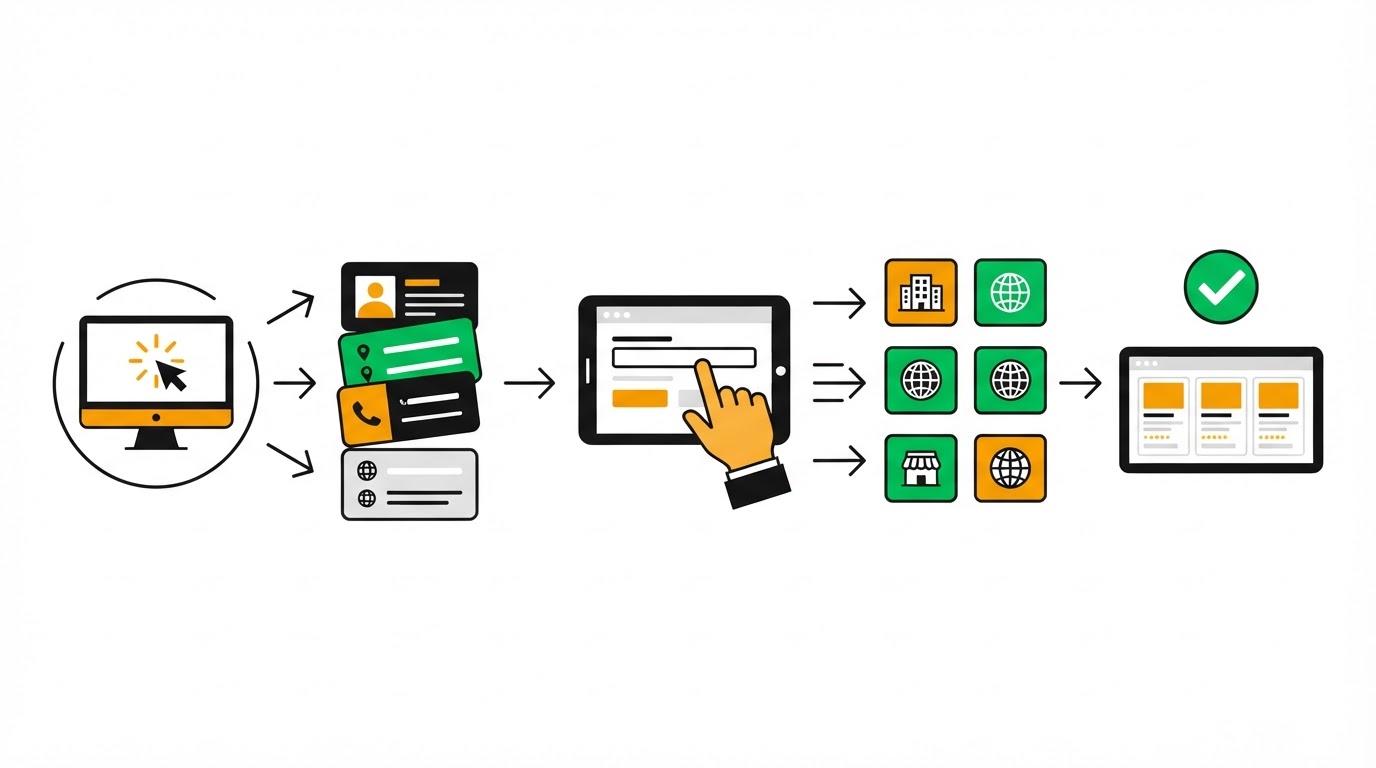
A business can lose trust quickly when its directory profiles show an old URL, a mismatched company name, or the wrong category. backlinksonautopilot.com is a backlink provider offering directory submission support for teams that want relevant listings handled with a documented process. Manual directory submissions give you control over the business information, category choice, landing page, and evidence for every placement.
Quick answer: how to complete manual directory submissions
Use this workflow for accurate, maintainable listings:
- Build one approved business-information sheet before opening any directory.
- Research each directory for audience fit, editorial quality, indexing, and live profile standards.
- Choose the narrowest accurate primary category, then add only useful secondary categories.
- Check for existing profiles and historical submissions before creating a new listing.
- Submit the approved details, record the live URL or pending status, and save verification evidence.
- Audit active listings on a recurring schedule after brand, URL, product, or contact changes.
Build a source-of-truth file before manual directory submissions
Collect the information once, approve it internally, and reuse it exactly where appropriate. This avoids small variations that turn into a cleanup project six months later.
Your source-of-truth file should include the legal business name, public brand name, root domain, preferred landing-page URL, short and long descriptions, logo URL, support email, social profiles, founding year, service areas, and category definitions. If your business has a physical presence, include the approved address and phone format as well.
Use one canonical URL format. For example, decide whether the company URL will be https://www.example.com/ or https://example.com/, then keep it consistent. Include UTM parameters only when a directory allows them and your analytics governance supports their use. A profile URL with tracking parameters can make future auditing harder.
Google advises businesses to represent their real-world name consistently in Business Profiles and to use categories that describe the core business activity. Its Business Profile guidelines are also useful as a general reference for accurate public business information.
Consider a hypothetical B2B SaaS company called SprintLedger. It sells subscription billing reporting for finance teams. Its approved listing record uses:
- Name: SprintLedger
- Website:
https://sprintledger.com/ - Primary landing page:
https://sprintledger.com/billing-analytics/ - Short description: “Billing analytics and revenue reporting for subscription finance teams.”
- Primary category: Billing analytics software
The team should avoid switching between “Sprint Ledger,” “SprintLedger SaaS,” and “SprintLedger Inc.” across profiles. Each version creates ambiguity for prospects, directory editors, and future internal audits.
How to find directories worth submitting to
A large list of directories creates busywork. Select sources that serve a real audience, cover your industry or geography, and maintain usable profile pages.
Start with four groups: major business directories, relevant industry directories, regional or local directories where you operate, and association or partner ecosystems. A SaaS company may benefit from software marketplaces, founder communities, startup databases, and specialist finance or operations directories. A local service company may prioritize map-based, chamber, neighborhood, and trade directories.
Review each candidate manually. Open several existing listings and look for active company pages, working outbound links, appropriate categorization, current dates, and a visible editorial standard. Skip sources filled with scraped profiles, unrelated outbound links, thin pages, or categories that cover every possible business type.
Use the same relevance discipline you would apply to any external placement. The guide to finding relevant backlink opportunities provides a useful framework for assessing audience and page fit before committing time to a source.
The following table gives SprintLedger a simple decision model. Score each directory before submission so the selection process can be reviewed later.
| Evaluation factor | What to check | SprintLedger decision |
|---|---|---|
| Audience fit | Finance, SaaS, or subscription-business users can reasonably use the directory | Submit |
| Category precision | “Billing analytics” or a close software category is available | Submit |
| Profile quality | Existing pages contain real company details and accessible links | Submit |
| Editorial upkeep | The directory shows recent listings, updates, or moderation | Submit |
| Duplicate risk | A profile already exists under the company name, domain, or former brand | Claim or update |
| Generic placement | Only broad categories with no relevant audience are available | Skip |
For link evaluation beyond directories, read What Are Quality Backlinks? A Practical Evaluation Checklist. A listing can be legitimate and still offer little strategic value when its audience and topic have no connection to your business.
Choose the right directory category for your business
Category selection shapes both discoverability and relevance. Pick the most specific category that accurately reflects the main product or service. Add secondary categories only when they describe established offerings with their own buyer intent.
For SprintLedger, “Accounting software” may be available, yet it is broad. “Billing analytics software” fits more closely. If the directory lacks that option, “Financial reporting software” is a sensible fallback. “Marketing software” would attract the wrong audience and dilute the profile’s purpose.
Read the category labels in context. Some directories use “Software” as a parent category with narrow subcategories, while others expose only high-level choices. Choose the closest available option and use the business description to clarify the specialization.
Write descriptions for humans first. Explain who the business serves, what problem it addresses, and the primary product area. Keep each directory’s character limits in your source file. This prevents rushed edits that remove essential context.
Avoid inserting promotional claims that a directory cannot support or that your site cannot substantiate. Keep language factual, current, and aligned with the landing page linked from the listing.
Prevent duplicate listings during manual directory submissions
Duplicate prevention starts before account creation. Search the directory for the business name, legal entity, domain, former domain, founder name, old phone number, and common name variants. Search engines can help surface profiles that the directory’s internal search misses.
For SprintLedger, a search reveals an old listing under sprint-ledger.io, a domain retired during a rebrand. Creating another profile would split the company’s references across two records. The correct next action is to claim or request an update to the old profile, then redirect or replace the website URL according to the directory’s process.
Keep a submission register with these fields: directory name, profile URL, account owner, email used, status, category, submitted date, live date, last reviewed date, and required follow-up. A spreadsheet is enough for a smaller campaign. Give each directory a unique identifier so the team can filter pending approvals and future renewal dates.
Duplicate listings commonly occur when sales, marketing, agencies, and local teams work from separate lists. Assign one owner for the master register. Require every contributor to check it before creating an account.
Google’s guidance on resolving duplicate Business Profiles illustrates a broader directory principle: consolidate public representations of the same business wherever the platform supports it.
Submit each listing and track its status
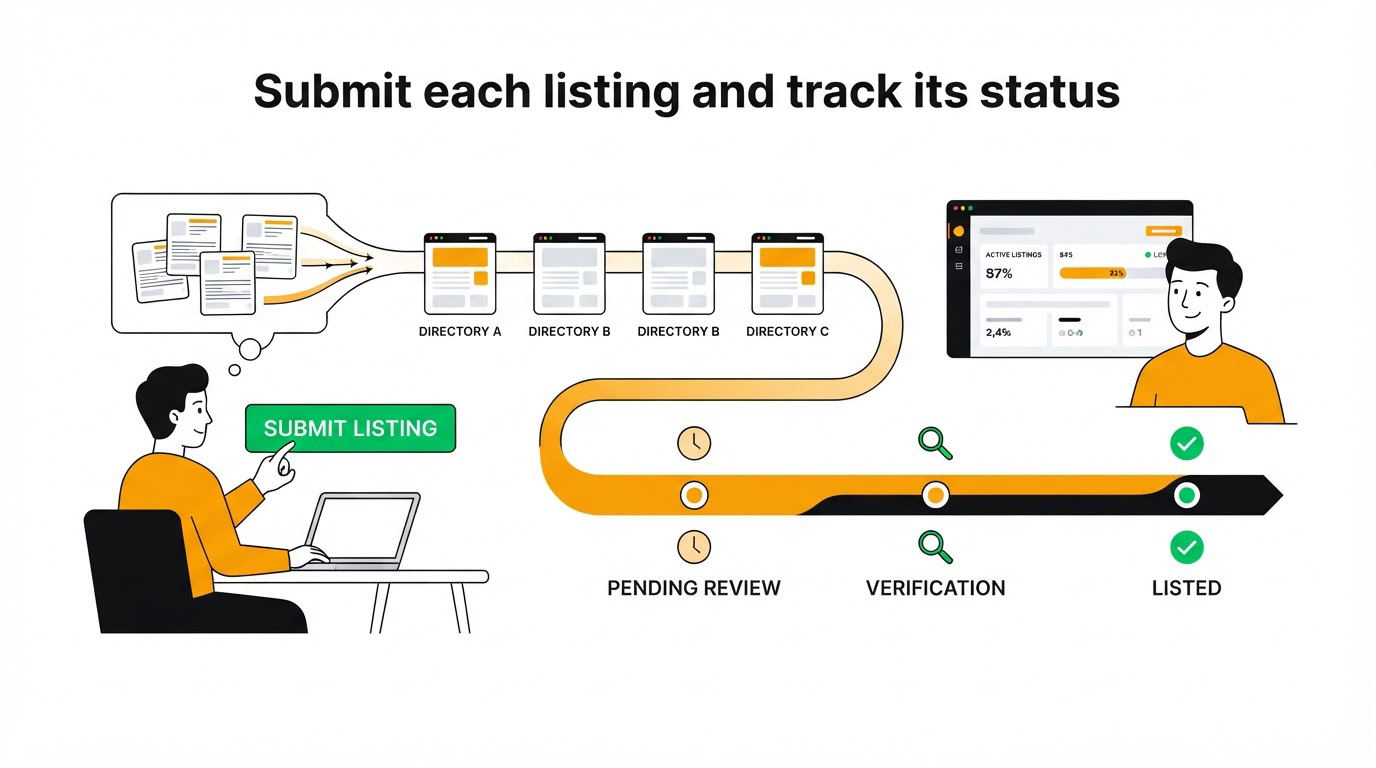
Complete every required field from the approved source-of-truth file, then read the finished preview before submission. Check spelling, category, destination URL, social links, and image quality. A live profile with a missing homepage link has limited value as a business reference and a referral path.
Record the outcome immediately. Use clear statuses such as “submitted,” “email verification required,” “editor review,” “live,” “claimed,” “rejected,” and “removed.” Add a short note when a directory requires a paid upgrade, an unavailable category, or a correction request.
SprintLedger submits to a software directory and receives an approval email three days later. The live page lists the product under “Accounting Tools” instead of “Billing Analytics.” The team records the live URL, opens a category-correction request, and keeps the listing in “live, correction pending” status. That note prevents a later audit from treating the placement as complete.
Save screenshots or confirmation emails for high-value listings. Evidence helps when a profile disappears, an account owner leaves the company, or an editor asks for verification again.
Use directory listings to support a SaaS referral program
Manual directory submissions can also create a clean path for qualified referrals. A SaaS company may send directory visitors to a product page, then invite existing customers, agencies, or integration partners into a formal referral or affiliate program after they understand the product.
Take SprintLedger as an example. The team could use a finance-software directory profile to send visitors to its billing analytics page, while maintaining a separate partner landing page for accountants and SaaS consultants who refer customers. This setup keeps the directory listing focused on accurate product discovery and gives partners a dedicated route for tracking referrals.
For businesses building that partner layer, affiliate tracking software for SaaS can support a structured program for affiliates and referrals, including workflows that need to work with Stripe-based billing. Keep the public directory profile, product destination, and partner-program messaging aligned so a visitor reaches the right page for their intent.
Treat referral URLs carefully. Use the same canonical company domain in the directory, keep partner tracking on designated program pages, and record any destination changes in the listing register. This preserves an auditable path from directory discovery to the appropriate conversion flow.
How Backlinks Autopilot supports directory submission work
Directory research and submissions require repetitive checks that are easy to rush: category fit, existing profiles, approved copy, account access, submission status, and listing evidence. A directory submission support workflow from Backlinks Autopilot can reduce the administrative load while keeping the business in control of the key decisions.
Start by providing the approved company details, target page, market context, and any directories that require exclusion. Confirm the business category and the audience you want to reach. For SprintLedger, that means finance and SaaS sources rather than generic marketing directories.
Next, review the submitted work against the same criteria used internally: correct brand name, relevant category, working destination URL, and a record of the completed placement. Keep your master register even when a provider performs the operational work. It remains the company’s reference point for future rebrands, domain migrations, and account changes.
For a wider view of what a managed provider should document, see this guide to a managed link building service. Clear scope and reporting make it easier to distinguish useful directory work from a volume-based submission campaign.
Maintain business listings after they go live
Listings need an owner after approval. Add a review cadence to your marketing operations calendar. Quarterly reviews work for many stable businesses. Review immediately after a rebrand, domain migration, office move, phone change, product repositioning, or category expansion.
During each review, open the live profile rather than relying only on your spreadsheet. Check the homepage URL, logo, category, description, contact details, and any user-suggested edits. Update the register with the review date and the action taken.
A practical maintenance sequence for SprintLedger looks like this: the company launches a new /revenue-forecasting/ product page, retains billing analytics as its main offering, and updates only directories where financial forecasting is a genuine secondary category. Its primary category remains unchanged. This avoids a scattered profile footprint where every listing describes a different company.
Directory listings work best as one part of a broader acquisition plan. If you are deciding whether recurring work fits your goals, one-time versus monthly link building explains how campaign scope, maintenance, and ongoing opportunity research differ.
FAQ about manual directory submissions
How many business directories should I submit to?
Submit to the number of directories that meet your relevance and quality criteria. A focused list of well-maintained industry, local, and business sources is easier to verify and maintain than a large generic list. Build the list in batches, review the live outcomes, then expand where you find additional relevant sources.
Should every directory listing link to my homepage?
Use the homepage when it best represents the business. Use a relevant product, service, or location page when the directory category and listing description clearly match that destination. Keep the destination stable, accessible, and consistent with the listing’s purpose.
Can I use different business descriptions on different directories?
Yes. Adapt descriptions to fit character limits and the directory audience while preserving core facts such as the business name, product focus, website, and contact details. Keep approved short and long versions in the source-of-truth file.
How do I find old duplicate directory listings?
Search the company name with current and former domains, legacy brand names, old phone numbers, and former addresses. Search within major directories directly, then review search-engine results for profile pages. Claim, update, merge, or request removal according to each directory’s available process.
Are directory submissions useful for a new website?
Relevant listings can help a new business establish accurate public references and referral paths. Prioritize established sources that serve your prospective customers, and avoid spending time on broad directories with weak profile quality. The guide on getting backlinks for a new website can help you place directory work within a sensible early-stage plan.
Manual directory submissions stay manageable when every listing starts with approved data, passes a relevance review, and ends in a maintained register. Use directory submission support when the operational workload exceeds your team’s capacity, while retaining approval over the business details and sources that represent your brand. Read next: SaaS Directory Submission Service: Which Listings Help Early-Stage Products Get Found.
Add backlinksonautopilot.com to your preferred sources in Google